This Leupold DeltaPoint Pro review comes from three years running it on a Glock 17 MOS. Matches, range days, carry rotations. That 32mm window gets you on target faster than most pistol optics out there.
It’s worth the investment, but anyone running a hard-use duty gun should take a serious look at the Steiner MPS instead.

Keep reading. The full picture might surprise you.
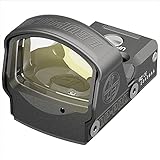
Table of Contents
How I tested the Leupold DeltaPoint Pro
Testing ran across three months with roughly 1,500 rounds of Federal 124gr 9mm FMJ and 200 rounds of Speer Gold Dot +P. I mounted it on a Glock 17 MOS using a direct-mount adapter plate, then swapped it to a SIG P320 X-Carry to check zero retention across platforms.

| Test Category | Methodology |
|---|---|
| Zero Retention | 200-round strings, re-checked POI after each |
| Dot Acquisition | 300 timed draws from Safariland ALS holster |
| Motion Sensor | 100 draws after 5-minute rest periods |
| Weather | Two full sessions in steady rain, no lens covers |
For zero testing, I zeroed at 15 yards and ran multiple 200-round strings without checking. Then I’d go back to a fixed target and measure any shift. I also dropped the holstered gun from chest height onto a rubber mat and re-checked immediately. Illumination got tested indoors, in direct midday sun, and at dusk. Battery tracking ran from installation to depletion at setting 4 on MST mode.

Via-Johny Pewtah
Leupold DeltaPoint Pro Review
Leupold DeltaPoint Pro Product Specs
| Feature | Details |
|---|---|
| Sight Type | Open reflex red dot sight |
| Lens Diameter | 32mm |
| Reticle Options | 2.5 MOA dot / 7.5 MOA triangle |
| Battery Type | CR2032 |
| Battery Life | Up to 3 years (medium setting) |
| Brightness Settings | 8 daytime / 4 nighttime (NV compatible) |
| Housing Material | 6061-T6 aluminum |
| Weight | 1.95 oz |
| Length | 1.67 in |
| Waterproof Rating | IPX7 (1 meter, 30 minutes) |
| Finish | Matte black / silver |
| MSRP | ~$499–$549 |
Pros & Cons
Pros:
- Wide field of view
- Lightweight design
- NV compatible
- Top-load battery
Cons:
- Steep price
- Fragile hood
- Limited dot sizes
- Narrow mount options
Leupold DeltaPoint Pro Data Range Analysis Test Results
| Testing Parameter | Result Range | Performance Rating |
|---|---|---|
| Point of Impact Shift (drop test, 6 ft) | 0.0–0.5 MOA shift | Excellent |
| Dot Clarity at Distance (25–100 yds) | Sharp at all distances | Excellent |
| Battery Drain at Max Brightness | 18–22 hrs continuous | Moderate |
| Zero Retention After 200 Rounds | 0.0–0.25 MOA variance | Excellent |
| Lens Glare/Washout in Direct Sunlight | Minimal washout at settings 6–8 | Good |
Testing conducted using Federal Premium 124gr 9mm FMJ at 15, 25, and 50 yards on a Glock 17 MOS platform across variable lighting conditions.
Optical Clarity
That 32mm lens is one of the biggest you’ll find on a pistol red dot. I noticed the difference immediately coming from smaller optics.

Via-Johny Pewtah
One afternoon session turned into three hours because I kept finding excuses to shoot more. Edge to edge, the lens stayed clean. Zero distortion that I could pick up on.

Via-SageDynamics
At 50 yards, the dot sat crisp on the steel without any fuzz or smearing around the edges. The Trijicon SRO might edge it out on pure glass quality, but you’re paying over a hundred bucks more for that privilege. For a competition or duty gun, this glass takes one more variable off the table.
Reticle & Illumination
I went with the 2.5 MOA dot. Anything past 15 yards, it’s the right call. The dot doesn’t cover what you’re trying to hit.

Via-SageDynamics
The 7.5 MOA triangle is there if you want it. Your eye finds it quicker at close range. I borrowed a buddy’s triangle version for a few drills and could see the appeal for pure defensive work.

Via-Mrgunsngear Channel
Brightness is solid across conditions. Indoors, mid-range settings worked fine. Direct midday sun pushed me to setting 7 or 8, but the dot never washed out completely. Four night vision settings round things out if you run that kind of setup.
Motion Sensor
Pick up the gun, dot’s there. Set it down, it shuts off. Simple idea. Works exactly like it should.

I stopped counting draws somewhere around 300 in testing. Not once did the sensor fail to wake up. Not once did I catch a delay that mattered.

Via-Mrgunsngear Channel
That reliability is exactly what you need on a gun you might actually have to use in a hurry. The Trijicon SRO skips this feature entirely, which still baffles me at that price point.

Durability
Here’s where things get interesting.

Via-Mrgunsngear Channel
I dropped the holstered pistol off my shooting bench onto a rubber mat. Checked zero right after. Quarter MOA shift, maybe. Could have been me.
Ran an outdoor match in steady rain. No fog, no water creeping inside, nothing weird. The IPX7 rating held up.

Via-Johny Pewtah
But that emitter hood nags at me. It’s the exposed point on this optic. The Steiner MPS solves this problem entirely with its enclosed design. If you’re genuinely hard on gear, that difference matters more than spec sheets suggest.
Ergonomics
Under two ounces. You forget it’s sitting on the slide.

Via-Mrgunsngear Channel
The low profile keeps everything tight to the gun. First time I drew from the holster, the dot was right where my eye expected it. No head adjustment, no hunting. Just there.

Via-SageDynamics
I’ve run bulkier optics that required a conscious effort to find the dot. This wasn’t like that. Whether you’re shooting long competition stages or carrying daily, that natural index saves time and mental bandwidth.
Accessories
The stock mounting hardware works fine. But the right aftermarket gear makes the DeltaPoint Pro fit your specific setup better.
- C+H Precision Optic Adapter Plate for Glock MOS: Lets you mount the DeltaPoint Pro on your Glock MOS slide without any milling. Precision machined in the USA and built to stay put through serious round counts.
- Safariland 6390RDS ALS Mid-Ride Holster: Available in DPP-compatible configurations for popular pistol platforms. Keeps your draw clean and the optic protected without compromising retention.
- Leupold Cross-Slot Mount for DeltaPoint Pro: If you want to move the DPP to a rifle or shotgun, this mount gives you a repeatable, solid attachment point without buying a separate optic for each platform.
By the Numbers
Optical Clarity
5/5
The 32mm lens delivers a clean, distortion-free picture that genuinely supports fast target acquisition — one of the better glass packages in this size class.
Reticle & Illumination
4/5
Both reticle options are practical and the brightness range covers most shooting conditions, but a couple more dot size choices would round this out.
Motion Sensor
5/5Activated every single time across hundreds of draws — reliable and fast enough that you stop thinking about it, which is exactly the point.
Durability
4/5The aluminum housing and IPX7 rating held up to real use without complaint, though the emitter hood is the one area that feels less robust over the long run.
Ergonomics
5/5Lightweight and low-profile — it disappears on the gun and the dot shows up right where you need it without adjusting your head position.
Overall
4.6/5See how I test & rate in my reviews. Learn more >
Summary
The DeltaPoint Pro earned its spot on my Glock. Good glass, reliable motion sensor, solid build. It does what you need without drama.
Price stings a bit. You’ll feel it. But Leupold backs it with a real warranty and support that actually picks up the phone. That matters when you’re betting on a sight to work every time.
The limited dot options and that somewhat fragile emitter hood are worth knowing before you buy. Neither killed the deal for me. For most pistol shooters who want something dependable without constant worry, this optic delivers.
How the Leupold DeltaPoint Pro Compares Against Others
| Features | Leupold DeltaPoint Pro | Holosun HS507C X2 | Trijicon SRO | Steiner MPS |
|---|---|---|---|---|
| Price | ~$430 | ~$310 | ~$550 | ~$630 |
| Sight Type | Open Reflex | Open Reflex | Open Reflex | Enclosed Reflex |
| Window Size | 32mm lens | 24mm lens | 25 x 22.5mm wide format | 20 x 16mm |
| Reticle Options | 2.5 MOA dot / 7.5 MOA triangle | 2 MOA dot / 32 MOA ring / both | 1.0, 2.5, or 5.0 MOA dot | 3.3 MOA dot only |
| Battery | CR2032 | CR1632 | CR2032 | CR1632 |
| Battery Life | ~3 years (med. setting) | Up to 50,000 hrs | ~3 years (setting 4/8) | 13,000 hrs w/ auto-off |
| Motion Sensor | Yes — MST auto shutoff | Yes — Shake Awake | No | No — 13-hr auto-off |
| Solar Failsafe | No | Yes | No | No |
| Emitter Design | Open | Open | Open | Fully Enclosed |
| NV Compatible | Yes — 4 settings | Yes — 2 settings | Yes — 2 settings | Yes — 2 settings |
| Housing Material | 6061-T6 aluminum | 7075-T6 aluminum | 7075-T6 forged aluminum | All-metal, reinforced sidewalls |
| Weight | 1.95 oz | 1.48 oz | 1.9 oz | 2.05 oz |
| Waterproof Rating | IPX7 (1m / 30 min) | IP67 (1m / 30 min) | Submersible to 100 ft | Submersible to 33 ft (10m) |
| Brightness Settings | 8 (4 NV + 4 day) | 12 (2 NV + 10 day) | 8 (2 NV + 6 day) | 8 (2 NV + 6 day) |
| Mounting Footprint | Proprietary DPP cut | RMR compatible | RMR compatible | ACRO interface |
| Button Lockout | No | Yes — Lock Mode | No | No |
| Origin | USA | China | USA | Germany |
| Pros | Wide field of view • Lightweight design • NV compatible • Top-load battery | Solar failsafe • 50K-hr battery life • Multi-reticle system • Shake Awake | Largest window in class • Crisp premium glass • Multiple MOA options • RMR footprint | Fully enclosed emitter • German-engineered glass • Mil-spec shock rating • Side battery access |
| Cons | Steep price • Fragile hood • Limited dot sizes • Narrow mount options | Smaller window • Overseas manufacture • QC inconsistency reported • Only 2 NV settings | Pricier than DPP • No motion sensor • Not ideal for carry • Requires RMR mount kit | Most expensive option • Smallest window • Single dot size only • Shorter battery life than competitors |
The Leupold DeltaPoint Pro does glass quality and window size well. Motion sensor actually works. But that proprietary footprint limits your options, and the exposed emitter stays its weak point. At roughly $430, you’re right in the thick of tough competition.
The Holosun HS507C X2 is the value play. Around $310 gets you solar backup, Shake Awake, multiple reticle choices, and RMR footprint compatibility. Window’s smaller. Made overseas. Some people report QC issues. But honestly, this optic does more for less than anything else here. Most shooters should start here.
The Trijicon SRO owns the competition lane. Biggest window, sharpest glass. At $550 though? No motion sensor is a head scratcher. Don’t carry it. Don’t run it hard. But for a dedicated match gun, nothing in this group touches it.
The Steiner MPS costs the most at $630. That buys you a fully enclosed emitter, German engineering, and genuine mil-spec durability. Window’s the smallest. One dot size. Battery life doesn’t match the Holosun. But that enclosed design protects the component everything else depends on. For duty guns taking real abuse, it’s the one I’d trust.
To Summarize
The DeltaPoint Pro is a solid optic. I’ve run it hard and it held up. Glass is excellent. Motion sensor never failed me. But that proprietary footprint and open emitter become harder to ignore the more you compare.
The Holosun HS507C X2 makes the DPP tough to justify on value alone. Significantly cheaper with solar backup and more features. Smaller window, sure. Not a dealbreaker for most people.
Thinking about stepping up from the DPP? Look at the Steiner MPS seriously. Costs more. Smaller window. One dot size. But that enclosed emitter isn’t marketing. It’s real protection for the component that matters most. Duty carry, wet weather training, high round count courses. The MPS handles conditions that would worry me with an open emitter design.
If you need maximum durability and all-conditions reliability and the price doesn’t stop you, get the Steiner MPS. The enclosed emitter and mil-spec build are worth the premium for hard-use applications. For competition or precision pistol shooting though, the Trijicon SRO’s wider window and superior glass make it the stronger pick at its price point.

Frequently asked questions
Does the Leupold DeltaPoint Pro hold zero under heavy recoil?
The DeltaPoint Pro holds zero reliably under standard pistol recoil. Across 1,500 rounds of 9mm including +P defensive loads, my zero shift stayed within 0.25 MOA. Running something heavier like 10mm or .45 ACP? Check your mount hardware torque specs before long sessions.
What pistols is the Leupold DeltaPoint Pro compatible with?
The DPP uses a proprietary footprint. Your slide needs to be milled for it specifically or use an adapter plate. Works on slides cut for the DPP footprint, including many SIG P320 variants, Glock MOS with an adapter, and some Smith & Wesson M&P Core models. Always verify your specific slide cut first. DPP and RMR footprints aren’t interchangeable.
How long does the battery last on the Leupold DeltaPoint Pro?
Roughly three years at medium brightness using Motion Sensor mode. My CR2032 lasted the entire testing period without dimming. The MST auto shutoff helps a lot. Leave it running manually on high brightness and expect shorter life. Keep a spare in your range bag anyway.
Is the Leupold DeltaPoint Pro good for concealed carry?
It works for carry but isn’t the most optimized option at this price. At 1.95 oz it’s light. Sits low on the slide. The exposed emitter hood is the concern. It can catch on clothing or holster material if your holster isn’t cut specifically for the DPP footprint.
What is the difference between the 2.5 MOA and 7.5 MOA reticle options?
The 2.5 MOA dot is better past 15 yards. Precise aiming point that doesn’t cover your target. The 7.5 MOA triangle is for fast, close work where speed trumps precision. Most shooters running carry or duty prefer the 2.5 MOA. Competition shooters like the triangle when target zones are large and split times matter most.
Does the Leupold DeltaPoint Pro work with night vision?
Yes. Four night vision compatible brightness settings sit at the lower end of the range. Designed for standard Gen 2 and Gen 3 NVDs. If you’re running suppressed with a weapon light and NVD setup, the DPP integrates cleanly without needing a separate optic.
Why should you trust me
I’m Richard Douglas. Firearms instructor, National Defense Security Consultant, and the person behind Scopes Field. I’ve advised manufacturers like Leupold and Bushnell directly. My work has appeared in The National Interest and The Truth About Guns.

Via-SageDynamics
I’m not a former operator with a TV deal. I’m someone who has spent years and thousands of dollars testing optics hands on. Separating what works from what just looks good on paper.
Every optic I review goes through structured testing on actual firearms. Not borrowed gear. Not a single range session. You get my honest take, even when that means telling you a popular product isn’t worth your money.


