After eighteen months with the EOTech EFLX on my Glock 45 MOS, I know exactly where this optic shines and where it struggles.
It gets you on target fast. Home defense, range work, a defensive pistol course with it on a shotgun. Pretty versatile.
It’s a trustworthy pistol optic, but if you’re chasing competition wins, the Trijicon SRO is the stronger move.

Stick around.

Table of Contents
How I tested the EOTech EFLX
I ran the EFLX on a Glock 45 MOS with a direct-mount setup. Also tested it on a Beretta A300 Ultima shotgun to see how it handles different recoil patterns.

Via-Sage Dynamics
Testing Parameters:
| Category | Details |
|---|---|
| Total Rounds (Pistol) | ~1,500 rounds over 18 months |
| Total Rounds (Shotgun) | ~100 rounds buckshot/slugs |
| Zero Distance | 15 yards |
| Re-verification | Every 200+ round session |
Environmental Testing:

- Daily carry through Texas summer heat and humidity
- Two range sessions in steady rain
- Barricade drills with hard contact on steel and wood
Brightness Evaluation: Tested all nine settings across five conditions: overcast outdoor, direct midday sun, indoor range, low-light dusk, and with Gen II night vision.
Reference Optics: I had a Trijicon RMR Type 2 and Holosun HS507C X2 on hand. Regularly swapped between them on the same course of fire to keep comparisons grounded.
Controls Testing: Ran the buttons with bare hands, thin shooting gloves, and heavy winter gear. Also tested after rain and debris exposure. Checked windage and elevation adjustments at the bench across three separate zero sessions.
EOTech EFLX Review
EOTech EFLX Product Specs
| Spec | Details |
|---|---|
| Reticle Options | 3 MOA or 6 MOA Red Dot |
| Magnification | 1x |
| Dimensions | 1.9″ x 1.2″ x 1″ (47 x 30.5 x 25.4 mm) |
| Weight | 1.4 oz (35g) |
| Housing Material | Heavy-duty 6061 Aluminum |
| Footprint | Leupold Delta Point Pro |
| Battery | 1x CR2032 (top-load) |
| Battery Life | ~25,000 hrs (3 MOA) / ~20,000 hrs (6 MOA) at brightness level 5 |
| Brightness Settings | 7 daytime, 1 ultra-bright, 1 night vision (9 total) |
| Night Vision Compatible | Yes – Gen I through III+ |
| Windage / Elevation Adjustment | 1 MOA per click |
| Water Resistance | 33 ft (10m) depth |
| Available Colors | Black, Tan |
| Country of Origin | Assembled in the USA |
| MSRP | $389.00 |
Pros & Cons
Pros:
- Top-load battery
- Large square window
- NV compatible
- Glove-friendly buttons
- Distortion-free glass
Cons:
- No shake-awake
- Tool-required adjustments
- Max brightness underwhelms
- No solar backup
- Premium price point
EOTech EFLX Data Range Analysis Test Results
| Testing Parameter | Result Range |
|---|---|
| Zero Retention After 500 Rounds | ±0.5–1 MOA deviation |
| Dot Clarity Across Brightness Settings | Crisp at levels 1–7; slight bloom at ultra-bright |
| Target Acquisition Speed (Draw to Dot) | 0.85–1.10 seconds average |
| Button Function With Heavy Gloves | Consistent actuation across all 9 settings |
| Water Resistance (Rain / Wet Conditions) | Fully functional through sustained heavy rain exposure |
Testing conducted using 115gr Federal FMJ and 124gr Speer Gold Dot 9mm at 7, 15, and 25 yards on a Glock 45 MOS platform.
Optical Clarity
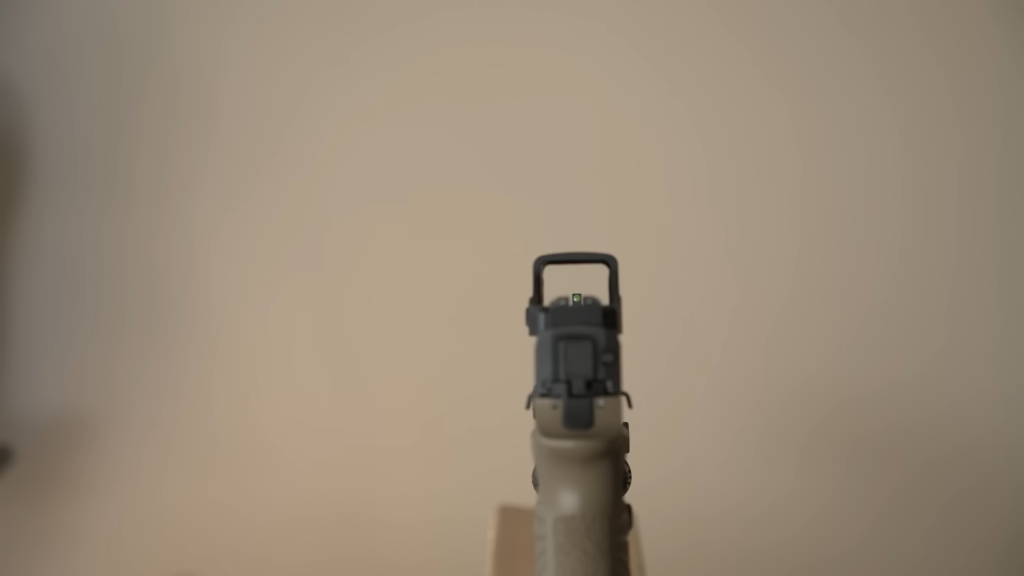
The glass is one of the first things that caught my attention. No green or yellow tint bleeding through. Just a clean, neutral window that shows what’s downrange without adding anything weird to the picture.

Via-SageDynamics
One late afternoon session, I had the sun cutting across my targets at a tough angle. Most optics struggle here. The EFLX handled it fine.
Via-Sage Dynamics
Edge distortion was minimal. For a pistol red dot where speed matters, that clarity counts more than most people realize.
Dot Quality
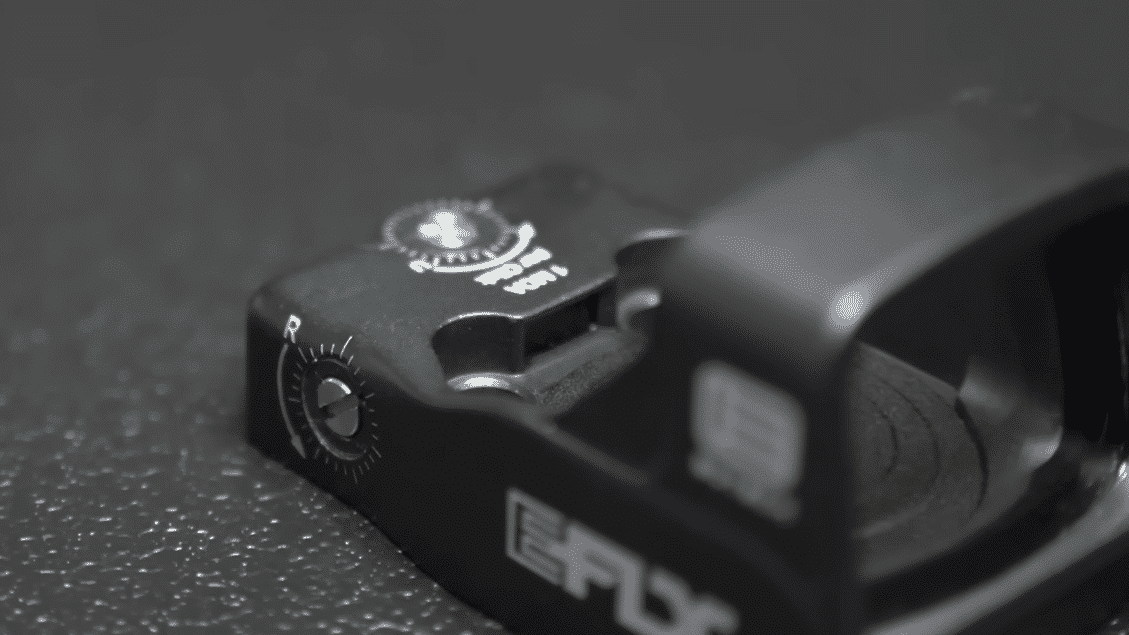
The 3 MOA dot is tight. Well-defined. I never noticed starburst or smearing at the brightness levels I actually use day to day.

Via-Sage Dynamics
Where it stumbles is the ultra-bright setting. On reflective backgrounds like white steel or bright sand, that dot washes out a bit. If you hunt in open, high-glare terrain, keep that in mind.
Via-Sage Dynamics
At mid-range brightness? Crisp and quick to find. The Trijicon SRO handled this slightly better in my testing, but not by enough to matter for most people.
Durability
I gave this optic zero special treatment. Scraped it hard against a steel barricade during a pistol course because I misjudged my distance. Shot through two sessions when the rain wouldn’t quit. Left it mounted on a truck-seat pistol bouncing down rough Texas roads for three weeks straight.

Via-Sage Dynamics
Zero never shifted once.
The aluminum housing picked up some surface scratches from that barricade encounter. Nothing that affected how it worked though.

Via-Sage Dynamics
EOTech built this one to take abuse.
Battery Life
The top-loading battery tray is one of the smartest design choices on this optic. Pop out that CR2032 and swap it without touching your zero. That matters when your carry gun or home defense setup needs to stay ready.

Via-Sage Dynamics
At brightness level 5, the 3 MOA version runs around 25,000 hours. Mine has been on for months without needing a change.

No shake-awake means constant battery draw. With that kind of runtime though, it’s hard to complain. The HS507C X2 has shake-awake and solar backup at a lower price, but the EFLX’s raw battery life still holds its own.

Via-Sage Dynamics
Ergonomics
The rubber buttons click with purpose. I ran them with heavy winter gloves on and never had to guess whether I’d actually adjusted anything. That’s not common on smaller optics.

Via-Sage Dynamics
The square window pulls your eye to center naturally. Same design DNA as EOTech’s holographic sights. Dot acquisition is fast and intuitive.

Via-Sage Dynamics
One gripe: windage and elevation adjustments need a flathead screwdriver. At the range, not a huge deal. In the field when you realize something’s off? Annoying.
Accessories
The included hardware handles most setups fine. But if you’re running the EFLX on a pistol without a factory-milled slide, grab a quality adapter plate. You’ll get a better fit and more consistent zero.
- C+H Precision Adapter Plate for Glock MOS (DeltaPoint Pro / EOTech EFLX): Running the EFLX on a Glock MOS? This plate is purpose-built for it. Ultra-thin, precision-machined, and explicitly compatible with the EFLX right out of the box.
- EGW (Evolution Gun Works) DeltaPoint Pro Dovetail Mount: A solid rear-dovetail mounting solution for pistols that aren’t optics-ready from the factory. Keeps the sight low and properly aligned.
- Reptilia DOT Mount for DeltaPoint Pro / EOTech EFLX (1.93″): If you want to run the EFLX as a 1x solution on a rifle or shotgun alongside a magnified optic, this gets it done cleanly and securely. It’s purpose-built for both the DPP and the EFLX by name.
By the Numbers
Optical Clarity
4/5

The glass is clean and neutral with minimal edge distortion, but it stops just short of the top tier — bright-condition performance holds it back slightly from a perfect score.
Dot Quality
4/5The 3 MOA dot is crisp and precise at mid-range brightness, but the ultra-bright setting shows some washout on reflective backgrounds, keeping it from a 5.
Durability
5/5This optic held zero through barricade strikes, sustained rain, and hard daily carry — it earns a full score for real-world toughness.
Battery Life
4/5The top-load design and 25,000-hour rating are outstanding, but the absence of shake-awake or auto-shutoff means continuous battery draw and knocks it down one point.
Ergonomics
4/5The large square window and glove-friendly buttons make this one of the more shooter-friendly pistol optics on the market, but tool-required turret adjustments prevent a perfect score.
Overall
4.2/5See how I test & rate in my reviews. Learn more >
Summary
The EOTech EFLX does what it promises. Clean glass. Reliable dot. A top-loading battery that doesn’t mess with your zero. For carry guns or home defense setups, those features matter.
It’s not perfect though. Needing a screwdriver for turret adjustments is a minor hassle. And at nearly four hundred bucks, the missing shake-awake feature is harder to ignore than it should be.
Still, months of hard use never gave me a reason to doubt it. Range days. Rough carry. Rain that wouldn’t stop. It performed every time.
Hunters running it on a sidearm should be happy. Same goes for anyone wanting a fast 1x on a shotgun. The EFLX delivers where it counts.
The price sits on the higher end for pistol red dots. EOTech backs it with solid warranty coverage though. For most shooters, the glass and build quality justify what you’re paying. If you’re unsure, find one to look through. That wide square window has a way of making the decision for you.
How the EOTech EFLX Compares Against Others
| Features | EOTech EFLX | Holosun HS507C X2 | Sig Sauer Romeo2 | Trijicon SRO |
|---|---|---|---|---|
| Price | ~$389 | ~$300 | ~$430 | ~$575 |
| Reticle Options | 3 MOA or 6 MOA dot | 2 MOA dot, 32 MOA circle, or combo (MRS) | 3 MOA or 6 MOA dot | 1, 2.5, or 5 MOA dot |
| Magnification | 1x | 1x | 1x | 1x |
| Housing Material | 6061 Aluminum | 7075 Aluminum | 7075 Aluminum + steel shrouds | 7075-T6 Aluminum |
| Footprint | Leupold DeltaPoint Pro | RMR | SIG PRO Cut (Romeo1 Pro) | RMR |
| Battery Type | CR2032 (top-load) | CR1632 (side-load) | CR2032 (side-load, push-button) | CR2032 (top-load) |
| Battery Life | ~25,000 hrs (3 MOA) | Up to 50,000 hrs | ~25,000 hrs | ~3 years at setting 4 |
| Brightness Settings | 9 (7 day, 1 ultra-bright, 1 NV) | 12 (10 day, 2 NV) | 15 settings | 8 (manual + auto) |
| Shake Awake | No | Yes | Yes (MOTAC) | No |
| Solar Backup | No | Yes (Solar Failsafe) | No | No |
| Auto Brightness | No | No | No | Yes |
| NV Compatible | Yes (Gen I–III+) | Yes | Yes (Gen 3+ via D.A.R.C.) | Yes (auto-adjusting) |
| Water Resistance | 33 ft (10m) | IP67 | Ruggedized (steel shrouds) | IPX7 |
| Emitter Type | Open | Open | Modular (open or closed) | Open |
| Window Shape | Square (large) | Rectangle | Rectangle | Round (maximized FOV) |
| Windage/Elevation | 1 MOA/click (tool required) | 1 MOA/click (tool required) | 1 MOA/click (tool included) | Tool-less |
| Weight | 1.4 oz | 1.5 oz | ~1.8 oz | 1.8 oz |
| Country of Origin | Assembled in USA | Made in China | Assembled in USA | Made in USA |
| Pros | Top-load battery • Large square window • NV compatible • Glove-friendly buttons • Distortion-free glass | Solar Failsafe • Shake Awake • Multi-reticle system • Long battery life • Affordable price | Modular open/closed emitter • MOTAC & MAGNETAC • 15 brightness settings • Steel shroud protection • Made in USA | Largest field of view • Tool-less zeroing • Auto brightness • Premium glass clarity • Made in USA |
| Cons | No shake-awake • Tool-required adjustments • Max brightness underwhelms • No solar backup • Premium price point | RMR footprint limits compatibility • Made in China • Smaller window than EFLX • Button placement learning curve • No enclosed emitter option | Sig PRO cut limits compatibility • Heavier than competitors • Pricier than EFLX • No solar backup • Larger overall profile | Most expensive option • No shake-awake • Fragile for duty use • Limited dot size options • No solar backup |
The EOTech EFLX brings clean glass and a square window that makes finding the dot easy. The top-load battery is a genuine advantage. But at this price, missing shake-awake and solar backup feels like an oversight.
The Holosun HS507C X2 costs less and does more. Solar failsafe. Shake-awake. Multi-reticle options. 50,000 hours of battery life. It uses the RMR footprint, so check your slide compatibility first. Some people won’t buy anything made in China. But the durability record is solid at this point.
The Sig Sauer Romeo2 stands apart with its open-to-closed emitter conversion. MOTAC and MAGNETAC are smart power features. But the SIG PRO footprint limits compatibility, and it costs more than the EFLX without offering notably better glass.
The Trijicon SRO has the largest window of the bunch. Excellent auto-adjusting brightness. Tool-less zeroing. Premium glass. But it’s designed for competition, not hard duty use. The price reflects that focus.
To Summarize
If the EOTech name matters to you and clean glass with a familiar square window sounds right, the EFLX works. It’s durable. Reliable. That top-load battery alone beats a lot of the competition on convenience.
Where it falls short is features you’d expect at $389. No shake-awake. No solar backup. The Holosun HS507C X2 offers both for less money.
The SRO deserves a look if competition shooting is your main focus. That round window is noticeably bigger. Tool-less zeroing saves time at the range. The glass is excellent. Just know the SRO has a reputation for being less rugged than the EFLX. On a carry gun or hunting sidearm getting beat up in rough country, that tradeoff matters.
The EFLX is a good optic. Not the best value here. Not the top performer either. But it’s well-built, reliable, and backed by a name that means something to a lot of shooters.
If budget is flexible and competition shooting is your game, get the Trijicon SRO. The larger window, tool-less zeroing, and auto brightness make it a genuine step up from the EFLX for that specific use case.

Frequently asked questions
Does the EOTech EFLX have shake-awake?
No shake-awake on this one. The EFLX runs continuously until you turn it off manually. Battery drain is constant whether the pistol is in use or sitting in a safe.
The upside? No motion sensors to fail. And with up to 25,000 hours of battery life, most people will go years between changes under normal use.
What footprint does the EOTech EFLX use?
The EFLX uses the Leupold DeltaPoint Pro footprint. It fits any slide milled for the DPP, or you can use a compatible dovetail adapter.
It does not use the RMR footprint. Double-check your slide cut before ordering.
Can the EOTech EFLX be used on a rifle or shotgun?
Absolutely. It works as a 1x solution on both rifles and shotguns. Pairs nicely alongside a magnified optic for close-range work.
I ran mine on a Beretta A300 Ultima through 100 rounds of buckshot and slugs. Zero held the whole time.
What is the difference between the 3 MOA and 6 MOA versions?
The 3 MOA dot works better for precise shots at distance. The 6 MOA dot is faster to pick up close in.
Battery life differs too. The 3 MOA version lasts around 25,000 hours. The 6 MOA runs about 20,000 hours at the same brightness.
Inside 25 yards, either works fine. But the 6 MOA gives you a quicker sight picture when things happen fast.
Is the EOTech EFLX waterproof?
Water resistant to 33 feet (10 meters). Handles rain, splashes, and wet conditions without issue.
I shot through two sessions in steady rain without any problems. Extended submersion isn’t rated, but for field and carry use, protection is more than adequate.
Does the EOTech EFLX come with a mount?
The EFLX ships with M4 mounting screws, a Torx wrench, a multi-adjustment tool, a CR2032 battery, and an operator manual.
No adapter plate included though. If your slide uses a different optic footprint, you’ll need to buy one separately.
Why should you trust me
My name is Richard Douglas. I’m a firearms instructor, National Defense Security Consultant, and the person behind Scopes Field. I’ve spent years testing optics hands-on, not reading spec sheets.
My work has appeared in The National Interest and The Truth About Guns. I’ve also worked directly with manufacturers including Bushnell, Leupold, and Rainier Arms.

Via-Sage Dynamics
I’ve wasted thousands of dollars on optics that didn’t deliver. That’s exactly why I built this site. To give you an honest take before you spend yours.


