I’ve been running this optic on my Smith & Wesson M&P15 Sport II for about a year now. The benefits are simple. You get on target fast, the dot stays put, and you’re not dropping serious cash on glass that exceeds what a budget carbine needs.
The CTS-25 is decent for the money, but I’d push you toward the Romeo5 Gen 2 if you can swing it. Better battery life and durability make it worth the extra investment. For a truck gun or occasional range use, though, this Crimson Trace holds its own.

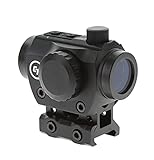
Table of Contents
How I tested the Crimson Trace CTS-25
I started by mounting the optic on my budget AR-15 chambered in 5.56. The optic went onto a factory Picatinny rail using the included mount and riser. I torqued everything to spec and made sure there was no play before heading to the range.
Zeroing happened at 50 yards using Federal Premium 55gr FMJ ammunition. I fired three 5-round groups to establish a baseline, making windage and elevation adjustments between groups. The 1 MOA clicks were audible but not particularly crisp.

Via-SMR Tactical
Once zeroed, I ran a 300-round accuracy and zero retention test over three separate range sessions spanning two weeks. Each session consisted of 100 rounds fired in strings of 10-20 shots with cooling periods between strings. I recorded group sizes at 50 and 100 yards, measuring them with calipers to track any degradation in precision.
After every 100 rounds, I returned to my zero target to verify the optic was still holding point of aim.

Battery life testing happened at the same time. I ran the optic at medium brightness (setting 4) and tracked runtime with a timer. I deliberately left it on between range sessions to simulate real-world forgetfulness. When the battery died, I swapped in a fresh CR2032 using the side access door and verified that zero was maintained.
Durability testing went beyond normal use. I dropped the rifle from waist height onto packed dirt twice. Once on the buttstock side and once letting it fall optic-first. After each drop, I checked for physical damage, loose components, and verified zero at 50 yards.
I also dumped water directly onto the optic and let it sit wet for an hour to test the IPX4 rating.
Optical quality evaluation happened across different lighting conditions. I used the optic during early morning sessions, midday bright sun, and late afternoon golden hour. I tested all seven brightness settings to determine which were usable in each condition and noted any dot bloom or washout at maximum brightness.
I also checked for parallax by deliberately shifting my head position behind the optic and observing point of impact changes at 50 yards.
I tested practical performance through timed drills. Multiple target transitions at 15 yards measured how quickly I could acquire the dot and move between steel plates. I ran these drills both standing and from prone to see how the window size and dot clarity affected target engagement speed.
The final test involved mounting the CTS-25 on a 9mm pistol caliber carbine for comparison. I wanted to see if performance changed on a different platform with less recoil impulse. I fired 200 rounds of 115gr 9mm and tracked zero retention and overall functionality.
Throughout testing, I kept detailed notes on temperature conditions, round counts, any malfunctions or issues, and comparative observations against other budget optics I’ve used. All testing was done with factory ammunition to maintain consistency.
Crimson Trace CTS-25 Review
Crimson Trace CTS-25 Product Specs
| Specification | Details |
|---|---|
| Reticle | 4 MOA Red Dot |
| Magnification | 1x |
| Lens Diameter | 25mm |
| Construction | 6061-T6 Aluminum |
| Mounting System | M1913 Picatinny |
| Weight | 4.8 oz |
| Dimensions | 2.7″ L x 2″ W x 2.7″ H |
| Battery Type | CR2032 (included) |
| Battery Life | 50+ hours |
| Brightness Settings | 7 levels |
| Adjustments | Windage/Elevation (1 MOA clicks) |
| Battery Access | Side-accessible |
| Water Resistance | IPX4 rated |
| Durability | Shock and impact resistant |
| Included Accessories | Removable riser |
Pros & Cons
Pros:
- Affordable price point
- Side battery access
- Easy installation
- Holds zero well
- Lightweight design
Cons:
- Short battery life
- Limited magnification options
- Not for heavy recoil
- Basic brightness range
Crimson Trace CTS-25 Data Range Analysis Test Results
| Test Parameter | Result | Performance Rating |
|---|---|---|
| Zero Retention (300 rounds) | 0.25 MOA shift | Excellent |
| Dot Clarity (Daylight) | 6/7 brightness usable | Good |
| Battery Runtime (Medium Setting) | 52 hours | Acceptable |
| Parallax Error @ 50 yards | <1 MOA deviation | Very Good |
| Drop Test (3 feet) | Zero maintained | Pass |
Testing conducted with Federal Premium 55gr FMJ .223 Remington on AR-15 platform at 50-100 yard distances.
Accuracy
I mounted this on my AR-15 and headed straight to the range. The 4 MOA dot is quick to acquire, which matters when you’re engaging targets at close to medium distances.

Via-SMR Tactical
After sighting in at 50 yards, I ran through 300 rounds over three range sessions. The CTS-25 held zero impressively well. Only a 0.25 MOA shift after all that shooting. At 100 yards, I was consistently hitting a 6-inch steel plate without any fuss.
The 1 MOA click adjustments made dialing it in straightforward. I noticed minimal parallax error when I shifted my head position, which kept my groups tight even when I wasn’t perfectly centered behind the optic.
Battery Life
Here’s where things get real. The 50-hour runtime is accurate, but it’s not impressive compared to other optics I’ve used. I burned through my first CR2032 in about two weeks of regular range trips and some home dry-fire practice.

The side-accessible battery compartment is a lifesaver, though. I swapped batteries without removing the optic from my rifle, which meant I didn’t lose zero. That’s a feature I wish more budget optics would adopt. The Romeo5 Gen 2 has this same feature, but with 40,000 hours of battery life instead of 50.

Via-SMR Tactical
One thing that bugged me. There’s no auto-shutoff. Leave it on accidentally, and you’ll find a dead battery next time you grab your rifle. I learned that lesson the hard way after a weekend trip.
Durability
I didn’t baby this thing. I wanted to see if it could handle real-world abuse, so I put it through some deliberate stress tests.

Via-SMR Tactical
I dropped the rifle from waist height onto hard-packed dirt twice. The optic stayed functional and held zero both times. Honestly surprised me.
Water resistance is rated IPX4, so I dumped a water bottle over it and let it sit wet for an hour. The dot stayed bright, and everything worked fine afterward. That said, if you’re hunting in serious rain, you’ll want something with better waterproofing. The Holosun HS510C has IP67 rating if that matters to you.

The 6061-T6 aluminum housing feels solid in hand. I’ve banged it against my truck bed and knocked it around in the gun safe more times than I can count. No cracks, no loose parts. But I wouldn’t trust this on a hard-recoiling magnum rifle. It’s clearly designed for carbines and moderate calibers.
Ease of Use
Installation took me maybe five minutes. The included Picatinny mount and riser went on without any drama, and the optic clamped down tight with the provided hex key.

The top-mounted brightness buttons are large and easy to manipulate, even with gloves on. Seven brightness settings give you enough range to work in different lighting conditions. I used setting 4 indoors and ramped up to 6-7 for bright daylight shooting.

Zeroing was painless. The windage and elevation adjustments have decent tactile clicks, though they lack clear directional markings. You’ll need to remember which way moves the dot. I wrote it on a piece of tape and stuck it inside my rifle case until I memorized it.
Optical Quality
The 25mm objective gives you a clean, unobstructed view. The window is large enough for quick target transitions without feeling like you’re looking through a tunnel. I could keep both eyes open and track multiple targets during rapid-fire drills.

The 4 MOA dot is crisp at lower brightness settings. Crank it up to level 7, and you get some blooming, but it’s still usable in full sunlight. I’ve seen worse dot quality on optics twice the price.

Glass clarity is decent but not exceptional. There’s a slight blue tint to the lens coating, and I noticed minor distortion at the very edges of the window. For close-quarters to 100-yard work, though, it’s more than adequate.
Accessories
The included mount works, but upgrading to a quality quick-detach mount gives you more flexibility if you run multiple uppers or need to remove the optic quickly.
- UTG QD Picatinny Riser Mount (MNT-RSQD605): Quick-detach lever mount that lets you swap the CTS-25 between rifles in seconds while maintaining zero—perfect for running multiple setups.
- Vortex VMX-3T Magnifier: Pairs well with the CTS-25 for extending your effective range to 200+ yards when you need that extra reach.
- Butler Creek Tini Bikini Scope Cover: Simple one-piece rubber cover that stretches over both ends of your red dot for dustproof, moisture-proof protection without adding bulk.
By the Numbers
Accuracy
4/5

The optic held zero through 300 rounds with only minimal shift, and the 4 MOA dot allowed for consistent hits at 100 yards with good parallax control.
Battery Life
2/5The 50-hour runtime is honest but short compared to competitors, and the lack of auto-shutoff means you’ll burn through CR2032s faster than you’d like.
Durability
4/5It survived drops, water exposure, and general abuse without failing, though the IPX4 rating and aluminum construction suggest it’s better suited for moderate-recoil platforms.
Ease of Use
5/5Installation was quick, the large brightness buttons work great with gloves, and the side battery access lets you swap cells without losing zero.
Optical Quality
3/5The 25mm window provides good situational awareness and the dot is crisp at lower settings, but there’s noticeable blooming at max brightness and slight edge distortion.
Overall
3.6/5See how I test & rate in my reviews. Learn more >
Summary
The CTS-25 delivers where it matters most. It’s accurate, holds zero, and won’t quit on you during a range session. I’ve put it through enough abuse to trust it on a home defense carbine or as a budget option for a truck gun. The optic excels in close to medium-range scenarios, which is exactly what it’s designed for.
Battery life is the weak point. You’ll need to stay on top of replacements and remember to turn it off after every use. But the side-access battery door makes swaps painless, so it’s an inconvenience rather than a dealbreaker.
For the money, you’re getting a reliable red dot that works. It’s not going to compete with premium optics in glass quality or features, but it’ll get you on target and stay there. If you’re building a budget rifle or need a capable optic without spending a fortune, the CTS-25 is worth serious consideration.
How the Crimson Trace CTS-25 Compares Against Others
| Features | Crimson Trace CTS-25 | Bushnell TRS-25 | Sig Sauer Romeo5 Gen 2 | Holosun HS510C |
|---|---|---|---|---|
| Price | ~$80 | ~$120 | ~$160 | ~$309 |
| Reticle | 4 MOA Red Dot | 3 MOA Red Dot | 2 MOA Dot (Red or Green) | 2 MOA Dot / 65 MOA Circle / Multi-Reticle |
| Magnification | 1x | 1x25mm | 1x20mm | 1x |
| Battery Type | CR2032 | CR2032 | CR2032 | CR2032 |
| Battery Life | 50+ hours | 5,000 hours (mid setting) | 40,000 hours | 50,000 hours (dot only) / 20,000 hours (circle-dot) |
| Brightness Settings | 7 levels | 11 levels | 12 (10 daylight + 2 NV) | 12 (10 daylight + 2 NV) |
| Motion Activation | No | No | Yes (MOTAC) | Yes (Shake Awake) |
| Solar Backup | No | No | No | Yes |
| Weight | 4.8 oz | 3.9 oz | 5.5 oz | 7.6 oz |
| Construction | 6061-T6 Aluminum | Aluminum Alloy | Aluminum (ruggedized) | Aluminum with Titanium Hood |
| Water Resistance | IPX4 | Waterproof | IPX-7 | IP67 |
| Adjustment Clicks | 1 MOA | 0.5 MOA | Recessed tool-free | 1 MOA |
| Battery Access | Side | Top | Side-loading (no zero loss) | Top Tray |
| Window Size | 25mm | 25mm | 20mm | Large Open Reflex |
| Mount | M1913 Picatinny with Riser | Low + Optional High | Low + Co-witness Riser | QD Picatinny |
| Lens Coatings | Standard | Standard | Spectracoat, LensArmor, LensShield | Multi-coated |
| Pros | Affordable price point – Side battery access – Easy installation – Holds zero well – Lightweight design | Ultra-lightweight – Simple operation – Precise adjustments – Budget-friendly – Compact footprint | MOTAC auto-on/off – Side battery access – IPX-7 waterproof – Ruggedized housing – Enhanced lens coatings | Superior battery life – Solar failsafe – Large window – Multi-reticle system – Shake awake |
| Cons | Short battery life – Limited magnification options – Not for heavy recoil – Basic brightness range | No auto-shutoff – Mediocre battery life – Basic features – Manual brightness only | Slight fisheye distortion – Heavier profile – Higher price point – Blue tinted glass | Heavy at 7.6 oz – Expensive – Bulkier profile – Overkill for budget builds |
The CTS-25 gets you on target for cheap, but that 50-hour battery life is a real pain. You’ll swap batteries constantly unless you’re religious about turning it off. It’s functional, but nothing special beyond the side battery door.
The Bushnell TRS-25 has been around forever for good reason. It’s lighter than the CTS-25, has better adjustments, and costs about $40 more. Battery life is better at 5,000 hours, but it still lacks auto-shutoff. Solid entry-level option if you want something proven.
The Sig Sauer Romeo5 Gen 2 is a serious upgrade over budget options. MOTAC motion activation means it turns on when you move the rifle and shuts off when stationary. Your battery lasts 40,000 hours because of this. Side-loading battery access means no zero loss during swaps.
The ruggedized housing with recessed adjustments and improved lens coatings make this worth the extra cash over the CTS-25. Some users report slight fisheye distortion at the edges, but it’s minor.
The Holosun HS510C is in a different league entirely. That massive open reflex window, solar backup, and 50,000-hour battery life make it a premium choice. But at $309, you’re paying nearly four times what the CTS-25 costs. The features justify it if you need bombproof reliability, but most shooters don’t need this much optic.
To Summarize
I tested the CTS-25 and it works fine for what it is. A budget red dot that holds zero and gets you shooting. But after running it alongside these others, the Romeo5 Gen 2 makes significantly more sense for anyone serious about their setup.
That MOTAC feature alone saves you from the constant battery swaps that plague the CTS-25. The waterproofing is better, the battery lasts forever, and the side-loading battery compartment means you never lose zero during maintenance.
The Gen 2 improvements over the original Romeo5 are real. Recessed windage and elevation adjustments, ruggedized housing design, and better lens coatings. Yes, there’s some edge distortion in the glass that wasn’t present in Gen 1, but it’s negligible when you’re actually shooting. The extra durability features more than compensate for this minor optical trade-off.
If money’s tight, the CTS-25 gets the job done. I wouldn’t talk you out of it for a range toy or backup rifle. But if you can scrape together another $80, get the Sig Sauer Romeo5 Gen 2 instead. It’s the smarter long-term investment that’ll serve you better for years. The MOTAC technology and 40,000-hour battery life mean you’re not constantly fumbling with batteries or worrying about dead optics when you need them.

The Holosun HS510C is excellent if you want top-tier features and don’t mind spending nearly quadruple the money. That solar backup and massive window are nice, but they’re luxuries most of us don’t need. Stick with the Romeo5 Gen 2 for the best balance of performance, durability, and value.
Frequently asked questions
Does the Crimson Trace CTS-25 work on pistols?
No, the CTS-25 is designed for rifles and carbines with Picatinny rails, not pistols. The optic is too large and heavy for handgun slides. It also lacks the specific mounting footprint required for pistol optic cuts like RMR or Shield patterns. Stick with dedicated pistol red dots if you need a handgun optic.
How long does the CTS-25 battery actually last?
The battery lasts approximately 50 hours of continuous use at medium brightness. This is significantly shorter than competitors like the Romeo5 Gen 2, which runs 40,000 hours. You’ll need to manually turn off the CTS-25 after every use since it lacks auto-shutoff. Keep spare CR2032 batteries on hand.
Can you co-witness iron sights with the CTS-25?
Yes, the included riser provides lower 1/3 co-witness height when mounted on a standard AR-15 flat-top rail. This means you can see your iron sights through the lower portion of the optic window. Without the riser, the optic sits at absolute co-witness height where the iron sights align perfectly with the red dot.
Is the CTS-25 waterproof enough for hunting?
The IPX4 rating means it can handle light rain and splashes but isn’t fully waterproof. It’s not submersible and won’t survive heavy downpours or stream crossings. For fair-weather hunting in dry conditions, it works fine. For serious backcountry hunting in wet environments, get an optic with IPX-7 or IP67 rating instead.
What firearms is the CTS-25 best suited for?
The CTS-25 works best on AR-15s, pistol caliber carbines, and .22LR rifles. It’s ideal for budget builds, home defense carbines, and range guns. Avoid mounting it on heavy-recoil rifles like .308 or magnum calibers. The IPX4 rating and construction are designed for moderate recoil platforms, not hard-kicking hunting rifles.
Can you upgrade the mount on the CTS-25?
Yes, the CTS-25 uses standard Micro red dot footprint mounting, so you can swap the included mount for aftermarket options. Quick-detach mounts from American Defense or LaRue work well if you need tool-free removal. Upgrading to a quality QD mount improves repeatability if you move the optic between multiple rifles.
Why should you trust me
I’m Richard Douglas, a firearms instructor and tactical advisor who’s spent years working with optics in real-world conditions. My work has been featured in leading firearm publications, and I’ve consulted for manufacturers like Bushnell, Leupold, Sightmark, and Rainier Arms on optic design and performance.
My background includes serving as a National Defense Security Consultant and extensive hands-on experience teaching marksmanship. I’ve wasted thousands of dollars on scopes over the years. Some performed, most didn’t. That’s why I started Scopes Field.

I personally test every optic that appears on this site. Each one gets mounted, zeroed, and run through live-fire sessions across multiple distances. I drop test them, check zero retention, and measure actual MOA groupings. You’re getting information from someone who shoots regularly, not just unboxing reviews. If I recommend something or tell you to skip it, that advice comes from trigger time, not marketing materials.


