Should you get a Vortex Crossfire or Vortex Diamondback riflescope?
That’s the exact question I had a year ago.
Since then, I’ve been hand-testing both these scopes’ durability, reticle, glass clarity, turrets, adjustments, and so much more.
By the end of this Vortex Crossfire vs. Diamondback review, you’ll know which riflescope is best for you.
Let’s dive in.
Vortex Crossfire II 4-12×50

Because the Crossfire II is also a Vortex scope, it will share some common features with the Diamondback and the Strike Eagle 1-8×24.
Like the Diamondback, the Crossfire II is also a single piece tube that’s made from aircraft grade aluminum.
It is 14.2-oz and completely shockproof. This makes it a great match for guns with a strong recoil.

The Crossfire has a nitrogen sealed O-ring. This is slightly different from an argon seal, but they both provide reliable waterproof and fog proof protection.
It has the standard Vortex fully multi-coated lens.

You can expect a bright, clear image in most lighting conditions.
But here’s my favorite part:
The Crossfire II boasts a whopping 3.9” of solid eye relief. Meaning, I won’t leave the range with a bruised eye, nor would I have to climb up my gun to get a complete field of view.
Speaking of which, the field of view is 25.7’ – 8.4’.
Not too bad, but this is the greatest FOV in this series and it is perfectly adequate for medium range shots and hunting.

Parallax adjustment on the Crossfire II goes from 10 yards to infinity.

This means you’ll be able to adjust for parallax 153 yards past your last yardage mark. This feature gives the Crossfire II a bit of an edge when comparing it to other scopes in this price range.
Speaking of similar price range, if you’re interested in a budget-friendly long-range scope that performs like $1,000 optics, check out my Athlon Argos BTR riflescope review.
Like most other Vortex optics, it also has a Dead Hold BDC (MOA) reticle with ¼ adjustment graduation.
All Crossfire scopes have a max windage and elevation adjustment of 50 (MOA).

The zero reset turrets are capped and have a clean click when adjusting.

However, there are two downsides to the Crossfire II:
First, I experienced a bit of fuzziness and glare at inclining magnifications.
Second, the scope’s image isn’t that bright when shooting in low-light conditions. The turrets are also very stiff at first. However, it loosens up with usage.
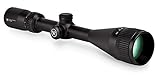
- The 4-12x50 Adjustable Objective Crossfire II riflescope is one of many configurations in the Crossfire II line. The Dead-Hold BDC reticle is good for hunting at varying ranges where estimating...
- The adjustable objective provides image focus and parallax removal to the user while anti-reflective, fully multi-coated lenses provide bright and clear views. The fast focus eyepiece allows quick and...
Vortex Diamondback 4-12×40

The Diamondback 4-12×40 is part of the wider Diamondback series from Vortex.
The 14.6 oz body is a one-piece tube made from aircraft grade aluminum alloy. It’s anodized coating provides enhanced durability.

Meaning, it can withstand the occasional drop or fall without damaging the performance. Just don’t make a habit of it 🙂

It has an argon sealed O-ring, making it completely waterproof and fog proof. You will never have to worry about internal fog or moisture with this optic.
As with all Vortex scopes, the Diamondback boasts a fully multi-coated lens.

This yields a crystal clear and bright image — even in low light conditions. In this regard, the Diamondback can hold its head high when compared to more expensive competition.
Another area where the Diamondback really shines is in “ease of use”.
The capped turrets have a strong, audible “click” when turned and allow for zero re-set. It holds zero with the consistency of an old friend.

Features like this really add to your confidence when you are out on the range or hunting. But the feature that really speaks is the…
Dead Hold BDC Reticle.

It’s a second focal plane reticle that is impressively accurate.
It completely takes the guesswork out of estimating bullet holdover. The parallax setting is a respectable 100 yards — making it perfect for use on most hunts.
Max elevation and windage adjustments are both 60 (MOA).

This is the lowest setting in the series but you could definitely be doing worse. None the less the performance is still really good. You can’t beat getting this kind of quality at this price point.
Although there is a lot to love about the Diamondback 4-12×40, it’s not all daisies and roses. Here’s what I didn’t like about it:
The field of view is supposed to be 32.4 – 11.3. However, I’ve experienced slight blurriness around the edges at magnification settings above 8x.
Also:
The 3.1” eye relief isn’t as forgiving as $500 optics.

To fix it, ensure you practice good cheek weld. Besides that, the Diamondback 4-12×40 is proven reliable and effective.
No products found.
With all that said, you might be wondering…
Which is better Vortex Crossfire or Vortex Diamondback?
With a price tag of around $200, the Diamondback 4-12×40 and the Crossfire II 4-12×50 are both well built budget scopes.

However, after spending over a year doing this Vortex Crossfire vs. Diamondback scope review, I’d give the winning trophy to the Diamondback 4-12×40.
No products found.
Here’s why. It’s got:
- Durability
- Holds zero
- Tracks true
- Easy to use
- Clear glass (even in low light)
Don’t get me wrong:
The Vortex Crossfire is a great scope. The eye relief is exceptional and the clarity is second to none. But if I had to pick between the two, I’d opt-in for a Vortex Diamondback.
But that’s enough from me. Now I’d like to turn it over to you:
Are you going to get a Vortex Diamondback? Or a Crossfire? Either way, let me know by leaving a comment down below.
Also, if you’re CQB shooter that’s looking for a budget-friendly red dot sight, check out my review on the Burris Fastfire 3 and Vortex Venom. Or you might be interested in my Sig Sauer Romeo red dot series review.


I ordered a crassfire 2 4x12x50 to replace the 3x9x32 Simons on my 7 mag
What about the diamondback 6-24 x 50 ffp scope?
I have 3 scopes…sniper nt hd 4-16×50 aogl,vortex 1-6×24 ar bdc3 and the vortex crossfire II 8-24×50
Did you test both scopes on the same rifle? If so what caliber? If not which rifle and calibers? I am snowed in at home in North East Texas right now. I have read several of you reviews and have decided to order the Vortex 1-8×24 strike eagle for my AR and i am now looking for a new scope for my sons .270 savage that i am going to have coated in the next month or so. Thanks for the great reviews so far!
get the croosfire with v-brite 3x9x50 got 3 of them that red dot helps out on those cool mornings
what in the world
I have a 3-9×40 Diamond back and a 2-7×32 Crossfire. The Diamond back has a wider field of view at minimum magnification even though it is more magnification. The “cost” for this is a little less eye relief than the Crossfire. The Crossfire also has a more forgiving eyebox, so it is easier to get aligned with the reticle. Both are great scopes.
My 3 x9 50mm crossfire is nice, but when you turn up the illuminated reticle the scope turns red.
Own a diamond and a hog hunter. Just ordered another diamond. Go Vortex!!