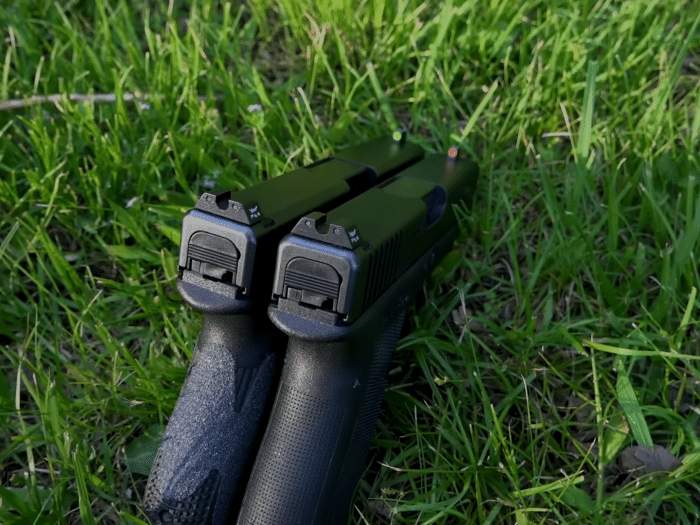
My SIG P365XL has worn the Romeo Zero Elite through a full year of daily carry. Hot range days, rain, and more holster cycles than I can count. It’s light, the dot stays clean without blooming, and the solar cell actually earns its keep in bright conditions.
It’s a dependable carry optic at a wallet-friendly price, though the Holosun HS507K X2 edges it out if you can spend a bit more — better housing, better glass, and a reticle system that gives you real options.
Here’s what a full year of actual carry use taught me about it.

No products found.
Table of Contents
How I tested the Sig Romeo Zero Elite
I mounted the Romeo Zero Elite on my SIG P365XL and ran it as my primary EDC for over a year. This wasn’t bench testing. It was carry, draw, shoot, repeat.

Via-Sig Sauer Inc
Zero and Platform Zeroed at 15 yards using 115gr Federal FMJ. Three five-shot groups confirmed, then I left it alone. Zero retention across daily holster cycles is make or break for me.
Testing Protocol
| Test Area | Method |
|---|---|
| Round Count | ~1,200 rounds (115gr FMJ, 124gr Gold Dot, V-Crown JHP) |
| Draw Drills | Timed from AIWB at 5, 7, 10 yards |
| Brightness | All 12 settings across low-light, shade, full sun |
| Shake Awake | Cold draws after 20+ minutes idle |
| Durability | Rain, Texas summer heat, accidental drops |
Comparison Baseline I ran a Holosun HS507K X2 on an identical P365XL setup during the same period. Not a scientific A/B test, but having both on near-identical platforms gave me useful context.

Ammo Used
- 115gr Federal FMJ (primary volume load)
- 124gr Speer Gold Dot JHP (defensive load checks)
- 115gr SIG Sauer V-Crown JHP (accuracy verification)
Sig Romeo Zero Elite Review
Sig Romeo Zero Elite Product Specs
| Feature | Details |
|---|---|
| Optic Type | Reflex Sight (Open Emitter) |
| Magnification | 1x |
| Lens Diameter | 24mm |
| Reticle | 3 MOA Red Dot / 6 MOA Red Dot |
| Illumination Settings | 10 Daylight + 2 Night Vision |
| Battery Type | CR2032 |
| Battery Life | Up to 50,000 hours (NV), 20,000 hours (daylight) |
| Water Resistance | IPX7 Rated |
| Mounting Interface | Shield RMSc / SYNC compatible |
| Weight | 1.1 oz |
| Dimensions | 1.77″ x 1.1″ x 1.1″ |
| Material | Polymer Housing |
| MSRP | ~$199–$229 |
Pros & Cons
Pros:
- Lightweight
- Crisp reticle
- Long battery life
- Affordable price
- NV compatible
Cons:
- Polymer housing
- Small window
- Exposed emitter
- Limited adjustability
- Fiddly battery tray
Sig Romeo Zero Elite Data Range Analysis Test Results
| Testing Parameter | Range | Result |
|---|---|---|
| Dot Clarity & Distortion | 7–25 yds | Minimal distortion, sharp dot |
| Zero Retention (50 rds) | 10 yds | Held zero consistently |
| Dot Washout (Bright Sun) | Outdoor / Full Sun | Slight washout at setting 6 and below |
| Target Acquisition Speed | 5–15 yds | Fast, consistent acquisition |
| Brightness Consistency | Settings 1–10 | Linear and predictable across all settings |
Testing conducted using 115gr Federal FMJ and 124gr Speer Gold Dot through a SIG P365XL at distances between 7–25 yards.
Optical Clarity
The Romeo Zero Elite uses a polymer lens. Yes, that’s the first question everyone asks. Compared to glass, you’ll notice a small difference at the edges.

But here’s the thing. This sight lives on a carry pistol. At 7 to 25 yards, where you’ll actually use it, targets are clear and transition drills feel natural.

Via-John ThruMyLens
I ran this hard at 10 and 15 yards. The lens never fought me once. If you’re comparing to the Holosun’s multilayer glass, sure, the 507K X2 has an edge. But for a budget carry optic, this gets the job done.
Dot Quality
The 3 MOA dot is clean. It doesn’t bloom into a fuzzy mess at moderate brightness, which I specifically watched for during draw-fire drills.

Via-StlletoCraft
The dot parked right where I needed it for fast target work at 10 and 15 yards.

Via-StlletoCraft
The 6 MOA option moves quicker but covers more of your target. If precision still counts on your carry gun, start with the 3 MOA. You can always try the bigger dot later if you feel like you need more speed.
Brightness Settings
Twelve settings give you solid coverage. Ten daylight, two NV. On a glaring afternoon, the top settings punched through fine. In a dark room, the low settings stayed dim enough to avoid blooming.
Here’s my gripe. A few of the middle steps feel almost identical. It won’t slow you down when things go sideways, but you’ll probably notice it when you’re dialing in your zero at the range.
Solar Performance
The solar cell supplements the battery. It’s not running the whole show by itself. Think of it as a helper, not a replacement.

Via-StlletoCraft
I ran this through a bright afternoon session at an outdoor range. The dot stayed consistent without me touching the brightness buttons. That’s the solar assist doing its job.
For a pistol that rides on your hip every day, any feature that adds power backup earns its keep. The Vortex Defender-CCW doesn’t have this, and I noticed the difference during hot summer range days.
Battery Life
SIG rates this at 20,000 hours on daylight settings. I’ve been running mine for months on a single CR2032 and haven’t touched it.

Via-Scott67
For a daily carry gun, you’re looking at one battery swap per year. Maybe less.

Via-Scott67
The shake awake feature helps preserve power when the gun sits idle. On a carry gun that spends most of its life in a holster, that matters more than you might think.
Durability
The polymer housing is where a lot of shooters hesitate. I get it.

Via-StlletoCraft
Here’s what happened in my year of carry. I dropped the pistol during a hard kydex draw once. Took it through wet range sessions. Baked it in a hot truck all summer. Every time I checked zero, it was right where I left it.

Via-StlletoCraft
The IPX7 rating handles rain and moisture without complaint. The Holosun and Vortex both use aluminum housing, and that does inspire more long-term confidence. But this polymer body didn’t let me down.
Ergonomics
The Romeo Zero Elite sits low and disappears on a subcompact. On my P365XL, it adds no meaningful bulk. The gun carries the same under a shirt.

Via-StlletoCraft
The adjustment caps are small. Bring a coin when you zero it. Clicks are positive and repeatable, and once you set zero, it stays put.
That’s really all you need from a carry optic. It fits, it stays out of the way, and it doesn’t make the gun print.
Shake Awake Performance
I set the pistol down for 20 to 30 minutes, then ran a draw from the holster. The dot was live before I reached full extension.
You’re not always going to remember to power on a red dot before you need it. Shake awake takes that variable off the table.

Via-John ThruMyLens
On a carry gun, this kind of instant response is worth more than most people give it credit for. The Trijicon RMRcc doesn’t have shake awake at all, and at triple the price, that’s a hard pill to swallow.
Accessories
The Romeo Zero Elite ships ready to run, but a couple of aftermarket additions will round it out depending on your carry setup and platform.
- OuterImpact Micro Red Dot Adapter for Sig P365: If your P365 slide isn’t already optics-ready, this is the no-mill dovetail solution — machined from 7075 aluminum right here in the USA and explicitly listed as compatible with the Romeo Zero.
- Night Fision Optics Ready Stealth Sights for Sig P365/P320: Purposely built to co-witness with slide-mounted micro red dots on the P365 — low profile enough to stay out of the window, there when you need them.
- Vortex Optics Lens Cleaning Pen: Toss this in your range bag and you’ll never squint through a smudged lens again — the dry carbon tip pulls fingerprints and fouling off the glass without any liquid or risk of damage.
By the Numbers
Optical Clarity
3/5

The polymer lens performs well at carry distances but doesn’t match glass in edge clarity. Inside 25 yards — where this optic is designed to work — it gets the job done.
Dot Quality
4/5The 3 MOA dot is clean and defined with minimal blooming at moderate settings. It’s the right size for fast, accurate target work on a carry pistol.
Brightness Settings
4/5Twelve settings cover the range from dark rooms to full afternoon sun effectively. A few mid-range steps feel too similar, but the overall spread is practical for carry use.
Solar Performance
4/5The solar assist keeps the dot sharp in bright conditions without manual adjustments. It’s a modest but meaningful layer of reliability on a gun you carry daily.
Battery Life
5/5Months of carry use on a single CR2032 with no drop in performance backs up SIG’s 20,000-hour rating. Battery life on this optic is impressive for the category.
Durability
3/5The polymer housing held zero through real-world abuse and handles rain without issue, but it still falls a step behind machined metal alternatives in long-term confidence.
Ergonomics
4/5Low-profile, lightweight, and clean on a subcompact carry gun. Small adjustment caps require a coin, but clicks are positive and zero is easy to set and hold.
Shake Awake Performance
5/5The dot came up fast and live during every draw drill I ran. On a carry gun, a shake awake this responsive is worth more than most people give it credit for.
Overall
4/5See how I test & rate in my reviews. Learn more >
Summary
The Sig Romeo Zero Elite sits at the affordable end of the micro optic market. Clean dot, long battery life, solar assist, and a shake awake that actually works. SIG backs it with a standard limited warranty, and their support team has been responsive in my experience.
The polymer housing is the real trade-off. It won’t inspire the same confidence as a steel-bodied optic, and some shooters will pass for that reason alone. That’s fair.
But if you’re getting into red dot carry without wanting to spend a lot upfront, this optic earns its spot. It does what it’s designed to do.
No products found.
How the Sig Romeo Zero Elite Compares Against Others
| Features | Sig Romeo Zero Elite | Holosun HS507K X2 | Vortex Defender-CCW | Trijicon RMRcc |
|---|---|---|---|---|
| Price | ~$209 | ~$240 | ~$210 | ~$499 |
| Housing Material | Polymer | 7075-T6 Aluminum | 7075-T6 Aluminum + ShockShield Insert | 7075-T6 Aluminum |
| Weight | 1.1 oz | 1.1 oz | 0.95 oz | 1.2 oz |
| Reticle Options | 3 MOA or 6 MOA Red Dot | 2 MOA Dot, 32 MOA Ring, or Both | 3 MOA or 6 MOA Red Dot | 3.25 MOA or 6.5 MOA Red Dot |
| Multi-Reticle System | No | Yes (MRS) | No | No |
| Brightness Settings | 12 (10 daylight + 2 NV) | 12 (10 daylight + 2 NV) | 10 (8 daylight + 2 NV) | 8 |
| Solar Assist | Yes | No | No | No |
| Shake Awake | Yes | Yes | Yes (Motion-Activated) | No |
| Battery Type | CR2032 | CR1632 (side-mounted tray) | CR1632 (side-mounted tray) | CR2032 |
| Battery Life | 20,000 hrs (daylight) | 50,000 hrs | 300+ hrs continuous | Up to 4 years |
| Water Resistance | IPX7 | IP67 | IPX7 | IPX7 |
| Mounting Footprint | Shield RMSc / SYNC | K Footprint (modified RMSc) | Shield RMS/RMSc | Shield RMSc |
| NV Compatible | Yes | Yes | Yes | Yes |
| Lock Mode | No | Yes | No | No |
| Lens Type | Polymer | Multilayer Reflective Glass | Aspherical Multicoated Glass | Multilayer Coated Glass |
| Lens/Emitter Design | Open Emitter | Open Emitter | Open Emitter | Open Emitter |
| Pros | Lightweight • Crisp reticle • Long battery life • Affordable price • NV compatible | Aluminum housing • Multi-reticle system • 50k hr battery life • Lock mode • Side battery tray | Lightweight • Wide viewing window • Aspherical glass • Strong lifetime warranty • Aluminum + ShockShield | Legendary durability • Patented housing • Premium glass • Wide compatibility • 4-year battery |
| Cons | Polymer housing • Small window • Exposed emitter • Limited adjustability • Fiddly battery tray | No solar • Adapter needed (some slides) • Slightly pricier • CR1632 (less common battery) | Fewer brightness settings • No solar • No multi-reticle • No shake awake auto-off memory | Very expensive • No shake awake • Fewer brightness settings • No solar • Steep price to entry |
The Sig Romeo Zero Elite is a solid entry-level carry optic. Solar assist and a clean dot at this price is nothing to sneeze at. The polymer housing works, but it doesn’t build the same confidence as aluminum. If budget is your main concern, it earns its place.
The Holosun HS507K X2 is the most feature-packed optic near this price. Aluminum housing, 50,000-hour battery, multi-reticle system, and lock mode. All that for about $30 more. The K footprint needs an adapter on some slides, which is annoying. But you’re getting more optic for your money.
The Vortex Defender-CCW competes hard at nearly the same price as the SIG. The aspherical glass is genuinely better, and Vortex’s lifetime warranty is legendary. It falls short on brightness settings and has no solar cell. But if warranty support matters to you, this is worth a serious look.
The Trijicon RMRcc is the premium pick. The build quality speaks for itself, and the brand trust runs deep. But paying more than double for fewer brightness settings, no shake awake, and no solar? That’s a tough ask unless maximum durability is your only priority.
To Summarize
The Sig Romeo Zero Elite is not the best optic on this list. I’ll say that plainly.
It’s a capable, affordable carry sight that does its job. But if a buddy asked me where to put his money today, I’d steer him toward the Holosun HS507K X2.
The Holosun costs a bit more, but it closes every gap the SIG leaves open. Aluminum housing. 50,000-hour battery. Multi-reticle system. Lock mode. These features matter on a gun you carry every day. The SIG’s solar cell is nice, but it doesn’t outweigh what Holosun brings to the table.
The Vortex Defender-CCW deserves consideration if warranty support is high on your list. The glass quality is a step up, and Vortex stands behind their products without question.
The Trijicon RMRcc is a different conversation. If you want the toughest micro optic money can buy, the RMRcc delivers. But for most people running a carry gun, the gap between the Trijicon and the Holosun doesn’t justify spending more than double.
If I had to pick just one from this group, I’d buy the Holosun HS507K X2. It gives you more optic for a modest price bump, and it sits on most P365-platform slides without modification.

Frequently asked questions
Does the Sig Romeo Zero Elite hold zero on a carry pistol?
The Sig Romeo Zero Elite holds zero reliably under normal daily use. Across 1,200 rounds on my SIG P365XL, the zero never shifted enough to affect performance at carry distances. Daily holster cycles, range sessions, and weather exposure didn’t cause any meaningful point-of-impact deviation. Torque your mounting screws properly at installation and zero retention won’t be a concern.
Is the polymer housing on the Romeo Zero Elite a problem?
The polymer housing is the most debated part of this optic, and the concern is fair. It’s not as inherently tough as machined aluminum, and you won’t feel quite the same long-term confidence.
That said, mine held up without issue through a full year of real carry. The carbon-infused construction and reinforced lens area do meaningful work. You get a lighter, more affordable optic. You give up some peace of mind on long-term durability. That’s the trade.
How long does the battery last on the Sig Romeo Zero Elite?
SIG rates it at 20,000 hours on daylight settings. With daily carry and shake awake cycling the optic on and off, you’re realistically looking at one battery swap per year. Maybe less.
The solar assist helps extend battery life in bright conditions. And the CR2032 is easy to find anywhere, so swaps are cheap and simple.
What pistols is the Sig Romeo Zero Elite compatible with?
The Romeo Zero Elite fits the SIG P365, P365X, P365XL, and P365 X-Macro directly without an adapter. It also works with pistols that have a Shield RMSc footprint, including the Springfield Hellcat OSP and Glock 43X MOS.
Four sets of mounting hardware ship with the optic. Always double-check your specific slide cut before buying since footprint tolerances can vary between production runs.
How does the Sig Romeo Zero Elite compare to the Holosun HS507K X2?
The Holosun HS507K X2 outperforms the Romeo Zero Elite in most areas. Machined aluminum housing. Multi-reticle system with a 2 MOA dot and 32 MOA circle. 50,000-hour battery life. Lock mode to prevent accidental setting changes.
The Romeo Zero Elite has solar assist and costs slightly less. But the Holosun offers more for a modest price increase. For most shooters, the Holosun is the smarter long-term buy.
Is the Sig Romeo Zero Elite good for night vision?
Yes. It includes two dedicated NV brightness settings below the standard daylight range. These keep the dot dim enough to avoid washing out your NV image.
The NV settings performed as expected in my testing. If you run night vision on a carry or home defense platform, this optic covers that use case without needing a separate sight.
Why should you trust me
My name is Richard Douglas. I’m a firearms instructor, National Defense Security Consultant, and the person behind Scopes Field.
My work has appeared in The National Interest, The Truth About Guns, and Cheaper Than Dirt. I’ve also worked directly with manufacturers like Bushnell, Leupold, and Rainier Arms.

Via-John ThruMyLense
I’m not a former military guy turned reviewer. What I am is someone who has spent thousands of dollars on optics, good ones and terrible ones, and built a process around telling the difference. Every optic I review gets real range time and real carry use before I write a word about it.
The Romeo Zero Elite is no different.