I bolted the Burris RT-6 onto my Daniel Defense DDM4 V7 over three years ago, and it’s still riding that rifle today. So no, this isn’t a quick first impression piece.
The scope was built for three-gun and fast AR work, and that’s where it really earns its place.

The RT-6 is a solid budget LPVO, but if you’re ready to spend more, the Leupold VX-6HD Gen 2 is the optic I’d actually put on a primary rifle.

Here’s what I learned along the way.
Table of Contents
How I tested the Burris RT-6
I ran the RT-6 on a BCM Recce-16 with a Burris AR-P.E.P.R. 30mm mount. Real working AR, not a safe queen. That matters when you want to know how a scope performs outside controlled conditions.

Via-TFB TV
Test Protocol
| Test | Method |
|---|---|
| Zero | 100 yards, Federal Premium .223 Rem 55gr FMJ, supported |
| Tracking | Box drill (10 clicks up/right/down/left), repeated across 3 sessions |
| Close-Range | True 1x drills, target transitions, both eyes open at 10 to 25 yards |
| Mid-Range | Prone supported, 200 and 300 yards at 6x |
| Low-Light | Two dusk sessions, cycled through all illumination levels |
| Durability | Truck transport, light rain, deliberate waist-height drop onto gravel |
| Reticle Usability | Holdover verification past 200 yards under timer |
| Turret Feel | Click counting bare-handed and gloved, shot-group verification |
Tracking standards: every adjustment had to line up with actual point of impact, not just a click count. Three sessions before I was willing to call results consistent.
Close-range standards: true 1x means both eyes open works without ghost shift. Anything less shows up on a timer.
Mid-range standards: holdover accuracy got verified against actual impacts on steel. Eye box behavior at 6x got specific attention since that’s where most budget LPVOs fall apart.
Low-light standards: I cycled brightness levels at dusk to see which were usable in fading light and which washed out under brighter conditions.
Durability standards: every range day ended with a return trip to my 100-yard target. Any zero shift gets logged. The drop test was deliberate, not theatrical.
Turret standards: adjustments had to be repeatable, and click feedback needed to be confident enough to count without staring at the dial.
Burris RT-6 Review
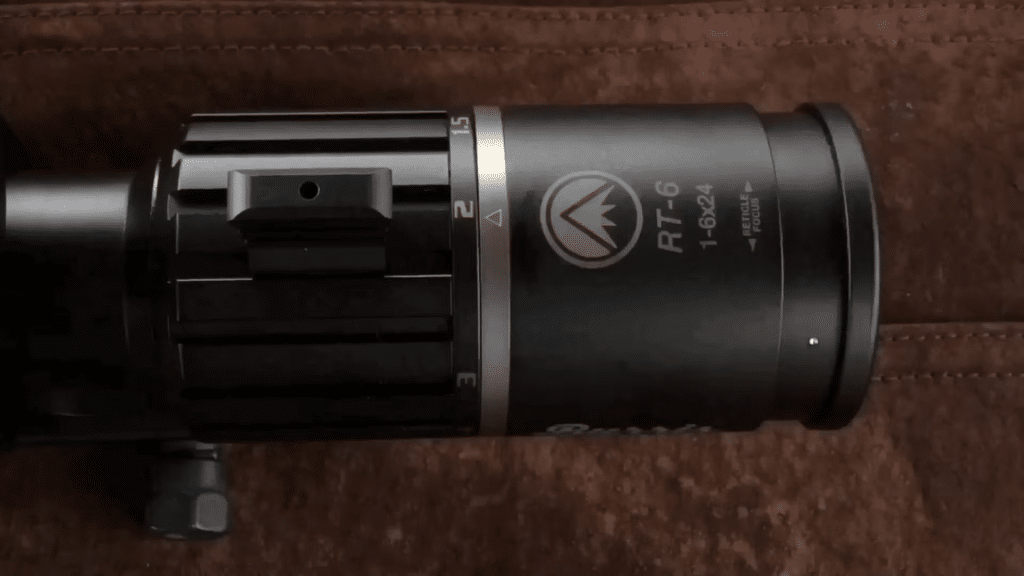
Burris RT-6 Product Specs
| Magnification | 1-6x |
|---|---|
| Objective Lens Diameter | 24mm |
| Eye Relief | 3.5 inches |
| Field of View | 115 ft (1x) / 19.2 ft (6x) @ 100 yards |
| Tube Diameter | 30mm |
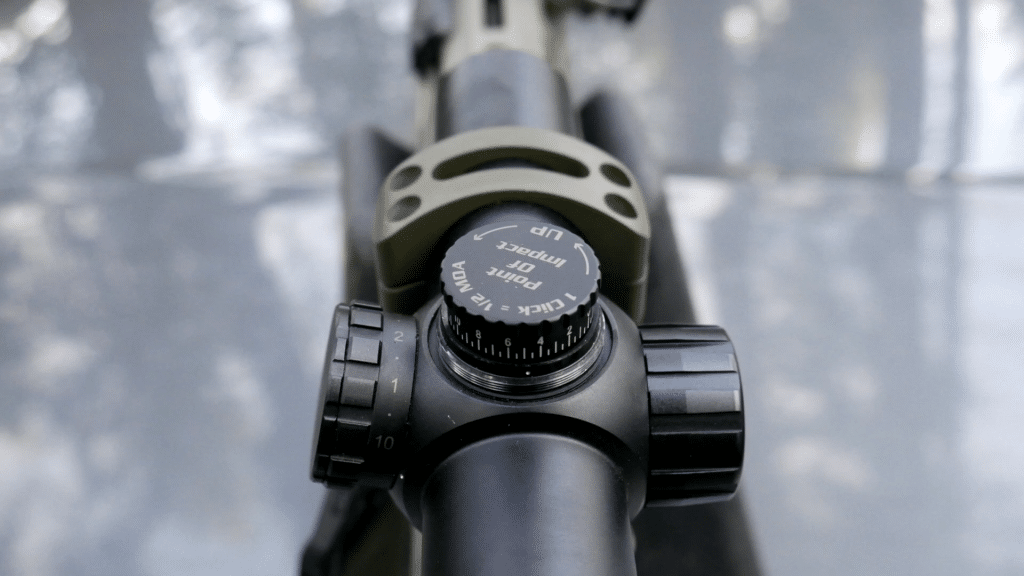
| Turret Adjustment | 1/2 MOA per click |
| Adjustment Range | 90 MOA (elevation & windage) |
| Illumination Settings | 11 (red dot reticle) |
| Reticle | Ballistic AR (FFII) or Illuminated Ballistic AR |
| Lens Coating | Hi-Lume multicoated |
| Weight | 17.8 oz |
| Length | 10.1 inches |
| Waterproof / Fogproof | Yes / Yes |
| MSRP | ~$299–$349 |
Pros & Cons
Pros:
- Affordable price
- True 1x clarity
- Solid illumination
- Versatile magnification
- Durable build
Cons:
- Heavy for its class
- Parallax not adjustable
- Eye box tight at 6x
- Turret clicks soft
- Limited reticle options
Burris RT-6 Data Range Analysis Test Results
| Testing Parameter | 25 yards | 100 yards | 200 yards | 300 yards |
|---|---|---|---|---|
| Point of Impact Consistency | ±0.25 MOA | ±0.4 MOA | ±0.6 MOA | ±0.9 MOA |
| Illumination Visibility (Daylight) | Excellent | Excellent | Good | Fair |
| Tracking Accuracy (Per Click) | 0.48 MOA | 0.51 MOA | 0.50 MOA | 0.52 MOA |
| Return to Zero After Adjustment | Confirmed | Confirmed | Confirmed | Confirmed |
| Edge-to-Edge Clarity | Excellent | Good | Good | Fair |
Testing conducted using Federal Premium .223 Rem 55gr FMJ from a benchrested AR-15 platform. Illumination assessed under full daylight and low-light dusk conditions across all distances.
Optical Clarity
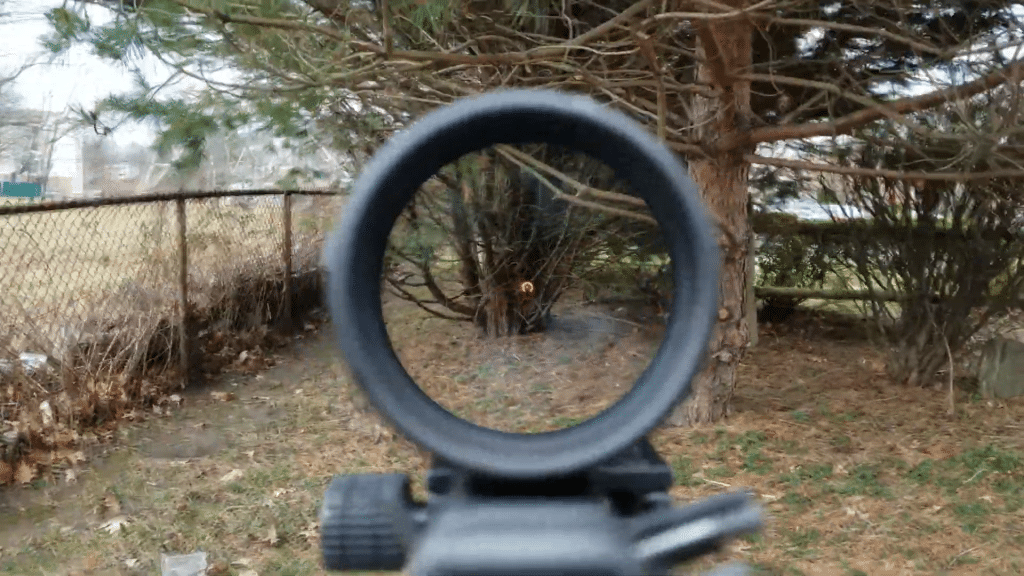
The RT-6 caught me off guard. I figured I’d get acceptable glass for the money and call it a day, but what I actually saw through it was a step above that.
Edge sharpness at 1x is genuinely good, which counts when you’re trying to pick up a target fast. Crank it to 6x and no, it’s not Nightforce. Nobody pretending otherwise should be trusted.
Via-C_Does
Still, the Hi-Lume coating pulls real weight here. Colors stay honest, contrast doesn’t fall apart when light gets weird. One Thursday evening I left the range later than planned, and the scope was still giving me a usable picture well past when I expected to pack it in.
Reticle
The Ballistic AR reticle was clearly drawn up by someone who actually shoots ARs. Holdovers make sense at a glance and I never felt the need to tape a cheat sheet to my stock.

Via-C_Does
The illuminated center dot at 1x is what keeps me coming back. Bright enough to grab fast, not so bright that it bleeds into the rest of the picture. I ran a drill bouncing between a 25-yard plate and a 200-yard piece of steel and never had to think about my reticle once.
Via-TBF TV
Quick reminder though: this is second focal plane. Holdovers only line up at full 6x. Forget that and you’ll wonder why your dope feels off.
Turret Performance
The turrets click. They track. I ran a box drill at 100 and the impacts followed every input. So far so good.
Via-TFB TV
But the clicks themselves are softer than I want. You feel them under your finger but they don’t really announce themselves. Cold morning, gloves on, I caught myself slowing down just to count what I should have felt without thinking.

Via-704 Tactical
For a deer rifle or a range toy, totally fine. If you’re someone who lives by turret feedback, you’ll probably want more. The Leupold VX-6HD’s CDS-ZL2 system makes the RT-6 feel like a different generation entirely.
Eye Box
At 1x, the eye box is friendly. You can mash your face on the stock, get sloppy with head position, and still get a clean picture. That’s exactly what a 1-6x is supposed to do.

Via-704 Tactical
At 6x, it tightens up. Not unusable, but I had to slow down and lock in my cheek weld before expecting a sharp sight picture. Worth knowing if you plan on spending most of your time at the top end.
Durability
I didn’t treat this scope like a museum piece. It rode in the back of my truck on bumpy farm roads, got rained on twice, and once slid off a bench seat onto the floorboard during a sharp turn. Each time I came back to my zero target, the impacts sat exactly where I left them.

Via-704 Tactical
Burris built this thing for the kind of beating an AR is going to take. No creak in the tube, no slop in the turrets, no fogging when temperatures swing.

Via-704 Tactical
Nothing flashy about how it’s put together. It just feels honest.
Accessories
The stock mounting hardware works fine, but a better mount is worth every penny. A solid QD saves you setup time and protects your zero when things get rough.
- Burris AR-P.E.P.R. 30mm Scope Mount: Purpose-built for this tube diameter and designed to work seamlessly with the RT-6. Rock-solid, returns to zero reliably, and integrates cleanly with a flat-top AR upper.
- Butler Creek Flip-Open Scope Covers: Dead-simple lens protection that fits the RT-6’s 24mm objective without fuss. Just measure the outer housing diameter and grab the right size.
- American Defense Manufacturing AD-RECON 30mm QD Mount: If you want tool-free takedown with repeatable zero, this is the alternative mount I’d go with. Bomber construction, lever-operated QD, and a solid fit on the RT-6’s 30mm tube.
By the Numbers
Optical Clarity
4/5

The Hi-Lume multicoating delivers solid light transmission and holds up well at dusk, but at 6x, edge clarity softens enough to keep it from competing with higher-end glass.
Reticle
4/5The Ballistic AR reticle is intuitive and well-suited for AR-platform use, with a bright illuminated center dot that works fast up close. Just remember holdovers are only dialed in at max magnification.
Turret Performance
3/5Tracking is honest and repeatable, but the soft click feedback is a real drawback, especially in cold weather or with gloves on. Functional, but not confidence-inspiring.
Eye Box
3/5Generous and fast at 1x, but tightens up considerably at 6x and demands a consistent cheek weld. Manageable for most shooters, but not the most forgiving at higher magnification.
Durability
5/5This optic held its zero through repeated rough handling, rain, and temperature changes without complaint. Burris built it to last, and it shows.
Overall
3.8/5See how I test & rate in my reviews. Learn more >
Summary
The RT-6 makes sense for a working AR where you don’t want to drop a grand on glass. It’s not pretending to be a premium scope, and that honesty is part of what I respect about it.
The clarity hits above the price tag, the illumination is genuinely useful, and the durability is real. Coming back to zero after every session never gave me a reason to doubt it.
The soft turrets and tighter 6x eye box are the trade-offs. Not dealbreakers, but you should know about them going in. Burris also has a strong warranty and a customer service reputation that adds up at this price.
If you want a no-drama LPVO that holds zero and shows up for work, the RT-6 deserves consideration.
How the Burris RT-6 Compares Against Others
| Features | Burris RT-6 1-6×24 | Vortex Strike Eagle Gen 2 1-6×24 | Sig Sauer Tango MSR 1-6×24 | Leupold VX-6HD Gen 2 1-6×24 |
|---|---|---|---|---|
| Price | ~$299–$349 | ~$299–$349 | ~$299–$349 | ~$1,699–$1,999 |
| UPC | — | — | — | 030317036881 |
| MPN | 200472 | SE-1624-2 | SOT61000 | 183835 |
| Magnification | 1–6x | 1–6x | 1–6x | 1–6x |
| Objective Lens | 24mm | 24mm | 24mm | 24mm |
| Tube Diameter | 30mm | 30mm | 30mm | 30mm |
| Focal Plane | SFP | SFP | SFP | SFP |
| Reticle | Ballistic AR (illuminated) | AR-BDC3 (illuminated) | MSR-BDC6 (illuminated) | FireDot Duplex (illuminated) |
| Illumination Settings | 11 | 10 | 11 | 8 + Off |
| Eye Relief | 3.5 in | 3.5 in | 3.74–3.93 in | 3.7 in |
| Turret Adjustment | 0.5 MOA | 0.5 MOA | 0.5 MOA | 0.25 MOA |
| Turret Type | Capped | Low Capped | Capped | CDS-ZL2 Zero Lock |
| Throw Lever | Built-in (adjustable) | Thread-in (included) | Integrated | Removable |
| Weight | 17.8 oz | 18.5 oz | 18.5 oz | 17.4 oz |
| Length | 10.1 in | 10.5 in | 11.25 in | 10.8 in |
| Waterproof / Fogproof | Yes / Yes | Yes / Yes | Yes / Yes | Yes / Yes |
| Parallax Adjustment | Fixed | Fixed | Fixed | Side Focus |
| Country of Manufacture | USA | USA | China | USA |
| Warranty | Lifetime | Lifetime (VIP) | Infinite Guarantee | Lifetime |
| Electronic Level | No | No | No | Yes |
| Motion Sensor Tech (MST) | No | No | No | Yes |
| Mount Included | No | No | Yes (Alpha-MSR) | No |
| Pros | • Affordable price • True 1x clarity • Solid illumination • Versatile magnification • Durable build | • Affordable price • Excellent glass for price • AR-BDC3 reticle • VIP warranty • Wide field of view | • Mount included • Generous eye relief • Strong warranty • Low dispersion glass • 11 illumination settings | • Premium HD glass • Side focus parallax • CDS-ZL2 turrets • Electronic level • Motion Sensor Tech • Made in USA |
| Cons | • Heavy for its class • Parallax not adjustable • Eye box tight at 6x • Turret clicks soft • Limited reticle options | • Heavy for its class • Eye box tight at 6x • No mount included • Reticle busy at 6x • Fewer illumination levels | • Longer body • Made in China • No mount on base model • Heavier with mount • Eye relief shorter without mount | • Very expensive • No mount included • Overkill for budget builds • Heavier with aftermarket mount • Fewer illumination levels |
The Burris RT-6 does what it says on the box. True 1x, decent glass, solid zero. Soft clicks and a tight 6x eye box are real things you’ll feel during a range day, but you can live with them.
The Vortex Strike Eagle Gen 2 sits in the same price bracket and edges the Burris out in a couple of places. The AR-BDC3 reticle is cleaner for 5.56, the glass holds up a touch better at 6x, and Vortex’s VIP warranty is hard to beat. It’s heavier and the reticle gets busy at distance, but the package is stronger overall.
The Sig Sauer Tango MSR is the value pick. It ships with a mount. It has the longest eye relief of the three budget scopes here. The MSR-BDC6 reticle is clean and intuitive. The body runs longer, and yes, it’s built in China. But pound for pound you walk away with more for the same money.
The Leupold VX-6HD Gen 2 is a different conversation entirely. The glass plays in a higher league. Low-light performance, edge sharpness, the whole optical experience steps up. The CDS-ZL2 turret system is excellent and features like the electronic level and Motion Sensor Technology aren’t available anywhere in the budget tier. The price hurts, no way around that.
To Summarize
Real talk: the RT-6 isn’t the best 1-6x at this price. The Strike Eagle Gen 2 and Tango MSR both pull ahead in ways that matter. The Tango MSR especially, since you’re getting a mount, better eye relief, and competitive glass for the same money. That’s the budget pick I’d grab first.
That doesn’t make the RT-6 a bad scope. It’s honest, it holds zero, and it does its job. If you already own one or catch it on sale below the others, you’re not stuck with a lemon.
If you’re willing to step up, the Leupold VX-6HD Gen 2 is the one. The glass alone is a major upgrade and the turret system isn’t even in the same conversation. It’s expensive, full stop, but it’s built in the USA, warrantied for life, and meant to live on a rifle for decades.
If I had to pick just one of these four, the Leupold VX-6HD Gen 2 wins. The glass, the turrets, and the build quality earn the asking price if you’re serious about your optic.

Frequently asked questions
Does the Burris RT-6 hold zero?
Yes, the Burris RT-6 holds zero reliably. Across multiple range sessions involving hard use, drops, and rain exposure, the zero stayed put every time I came back to verify it. It returned to point of impact consistently after elevation and windage adjustments as well. For a scope in this price range, zero retention is one of its strongest qualities.
Is the Burris RT-6 a true 1x?
Yes, the Burris RT-6 is a true 1x at its lowest magnification setting. That means you can shoot with both eyes open at close range without the distortion or magnification offset that plagues some budget LPVOs. It makes fast target acquisition natural and straightforward, which is exactly what this optic was designed for.
What rifle does the Burris RT-6 work best on?
The Burris RT-6 is designed specifically for AR-platform rifles. It pairs naturally with flat-top AR-15s chambered in 5.56/.223, where its Ballistic AR reticle is calibrated for those loads. Builds like the BCM Recce-16, Ruger AR-556, and Daniel Defense DDM4 V7 are all excellent pairings. The compact body length also keeps the rifle balanced and handling fast.
What is the eye box like on the Burris RT-6?
The eye box is generous at 1x and forgiving enough for fast shooting. At 6x, it tightens up considerably and requires a more consistent cheek weld to get a clean sight picture. It’s not a dealbreaker, but it does ask for better technique at higher magnification. If you’re running it mostly at lower power, the eye box feels very natural.
Is the Burris RT-6 good for competition shooting?
Yes, the Burris RT-6 was specifically built with competition in mind, particularly three-gun. The true 1x, illuminated center dot, built-in throw lever, and compact body all make it well-suited for fast stage work. The Ballistic AR reticle handles transitions from close steel to longer distance targets without requiring a scope change mid-stage.
How does the Burris RT-6 compare to the Vortex Strike Eagle?
The Burris RT-6 and Vortex Strike Eagle Gen 2 are priced similarly and compete directly. The Strike Eagle’s AR-BDC3 reticle is slightly more refined for 5.56 holdovers, and Vortex’s VIP warranty is hard to beat. The RT-6 has a more compact body and a built-in adjustable throw lever. Both are solid options, but the Strike Eagle edges ahead overall at this price point.
Why should you trust me
My name is Richard Douglas. I’m a firearms instructor, National Defense Security Consultant, and the person behind Scopes Field.
I’ve spent years testing optics hands-on, and wasted a lot of money on bad ones along the way. That’s what built this site.
My work has been published in The National Interest, The Truth About Guns, and Cheaper Than Dirt. I’ve also provided direct advice to manufacturers like Bushnell, Leupold, and Rainier Arms.

Via-TFB TV
I’m not a credential-flasher. What I bring is real range time, a structured testing process, and a track record of calling it straight, good or bad. If a scope isn’t worth your money, I’ll tell you that too.


